


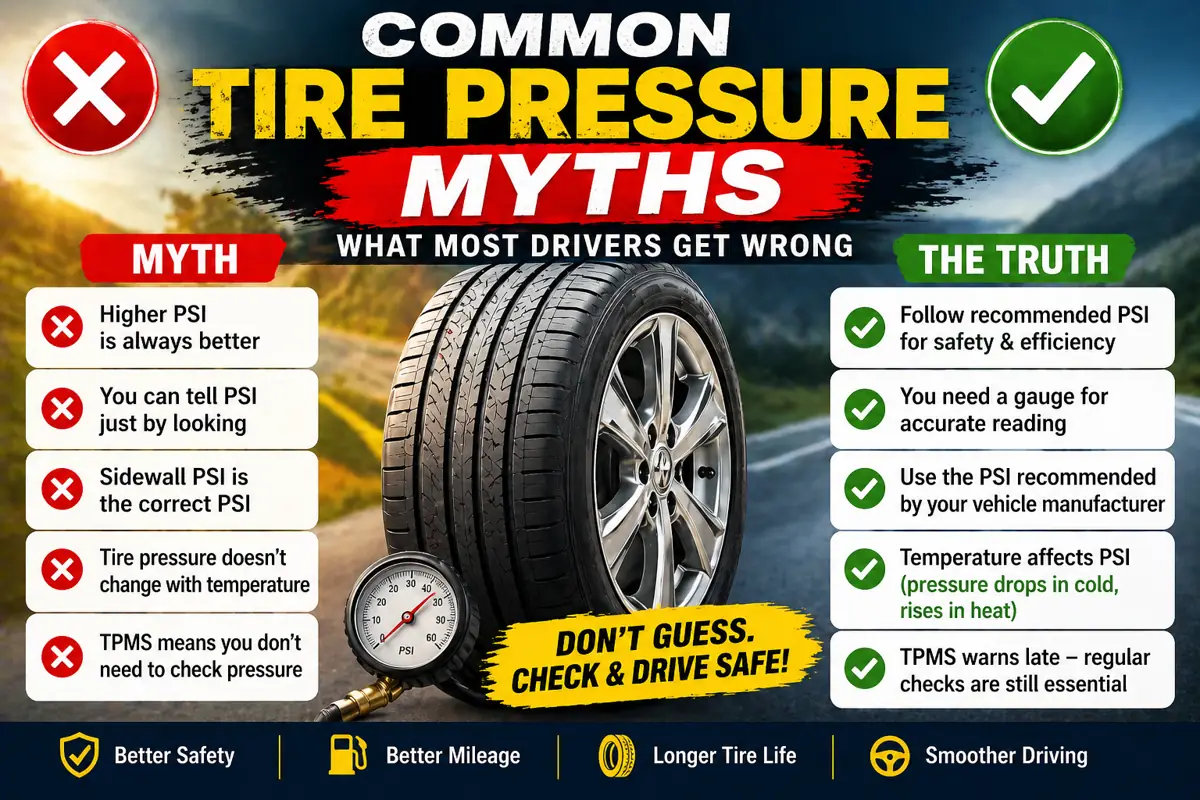
Common tire pressure myths often lead drivers to make simple mistakes that affect safety, fuel efficiency, and tire life. Many people rely on assumptions like “higher pressure is better” or “you can tell by looking,” but these beliefs are often incorrect.
Understanding these tire pressure myths helps you make better decisions, avoid uneven tire wear, and maintain proper traction on the road.

Most common tire pressure myths:
- Higher tire pressure improves fuel economy
- You can judge pressure by looking at the tire
- Tire sidewall PSI is the correct pressure
- Tire pressure doesn’t change with temperature
- TPMS always keeps you safe
These myths can reduce safety and tire performance
Why Tire Pressure Myths Are So Common
Many myths come from partial truths or outdated advice.
- Older tire designs behaved differently
- Visual checks were more common in the past
- Fuel-saving tips are often misunderstood
Small misunderstandings can lead to long-term driving habits that reduce safety and efficiency.

Myth 1: Higher Tire Pressure Improves Fuel Economy
This is one of the most common misconceptions.
The truth:
Higher tire pressure can slightly reduce rolling resistance, but it also reduces the tire’s contact with the road.
Cause → Effect → Outcome:
Overinflation reduces the contact patch, which decreases traction. This leads to reduced grip during braking and cornering, especially at higher speeds.
Real world insight:
Some drivers inflate tires above recommended PSI thinking it saves fuel. In reality, even a small increase of 3–5 PSI can lead to uneven tread wear and reduced stability over time.
Myth 2: You Can Tell Tire Pressure Just by Looking
Many drivers rely on visual checks instead of using a gauge.
The truth:
Modern radial tires are designed to maintain their shape even when pressure drops.
Result:
A tire can be underinflated by 5–10 PSI and still look normal.
Real world observation:
Drivers often notice handling issues before they notice any visible change in the tire.
Myth 3: The PSI on the Tire Sidewall Is the Correct Pressure
This is one of the biggest misunderstandings.
The truth:
The PSI on the tire sidewall indicates the maximum pressure, not the recommended pressure.
The correct PSI is determined by the vehicle manufacturer.
Tire manufacturers like Michelin design tires to operate within a range, but the optimal pressure depends on vehicle weight, suspension, and load.
Myth 4: Tire Pressure Doesn’t Change Much
Some drivers believe tire pressure remains constant.
The truth:
Tire pressure changes with temperature.
- Drops in cold weather
- Increases in heat
Even a 10°F change can affect tire pressure by about 1 PSI.
Real-world example:
A properly inflated tire in summer can become underinflated in winter without any visible warning.
Myth 5: TPMS Means You Don’t Need to Check Pressure
Many drivers rely entirely on TPMS (Tire Pressure Monitoring System).
The truth:
TPMS alerts you only after pressure drops significantly.
It does NOT:
- Detect small pressure losses early
- Maintain correct pressure
Tire experts and brands like Bridgestone recommend regular manual checks even if TPMS is active.
Myth 6: Lower Pressure Gives Better Grip
Some drivers believe slightly lower pressure improves traction.
The truth:
Lower pressure increases the contact patch, but not in a controlled way.
Cause → Effect → Outcome:
Excessive tire flex generates heat, which weakens the tire structure and reduces stability. Compared to properly inflated tires, underinflated tires lose control faster and wear unevenly along the edges.
How Tire Pressure Affects Driving
Tire pressure directly controls the contact patch, which is the area of the tire touching the road.
- Correct pressure → even contact, better traction
- Low pressure → increased friction, heat buildup
- High pressure → reduced contact, less grip
Incorrect pressure increases braking distance and reduces handling stability, especially during emergency situations.
What You Should Actually Do
Instead of relying on myths:
- Follow the recommended PSI
- Check tire pressure at least once a month
- Adjust for temperature changes
- Use a pressure gauge, not visual checks
These simple steps prevent most tire-related issues.
Common Mistakes Caused by Myths

- Overinflating for “better mileage”
- Ignoring gradual air loss
- Trusting TPMS alone
- Using sidewall PSI as a guide
These mistakes reduce tire lifespan and compromise safety.
Safety Impact
Believing tire pressure myths can lead to:
- Reduced traction
- Longer braking distance
- Increased risk of tire failure
Proper tire pressure is one of the simplest and most effective ways to improve driving safety.
Real World Observation
Many drivers say:
“I thought I was doing it right”
But in reality:
- They were following outdated or incorrect advice
- Small pressure differences added up over time
Conclusion:
Tire pressure myths are easy to believe, but they often lead to poor decisions.
If you:
- Understand how tire pressure actually works
- Follow recommended PSI
- Check regularly
You’ll improve safety, fuel efficiency, and tire life.
FAQs
Is it better to overinflate tires slightly?
No. Overinflation reduces traction and causes uneven wear.
Can I check tire pressure without a gauge?
No. Visual checks are not accurate.
Does tire pressure really change with temperature?
Yes. Pressure drops in cold weather and increases in heat.
Is the PSI on the tire sidewall correct?
No. It shows the maximum pressure, not the recommended level.
Can I rely only on TPMS?
No. TPMS alerts late and does not replace manual checks.

