



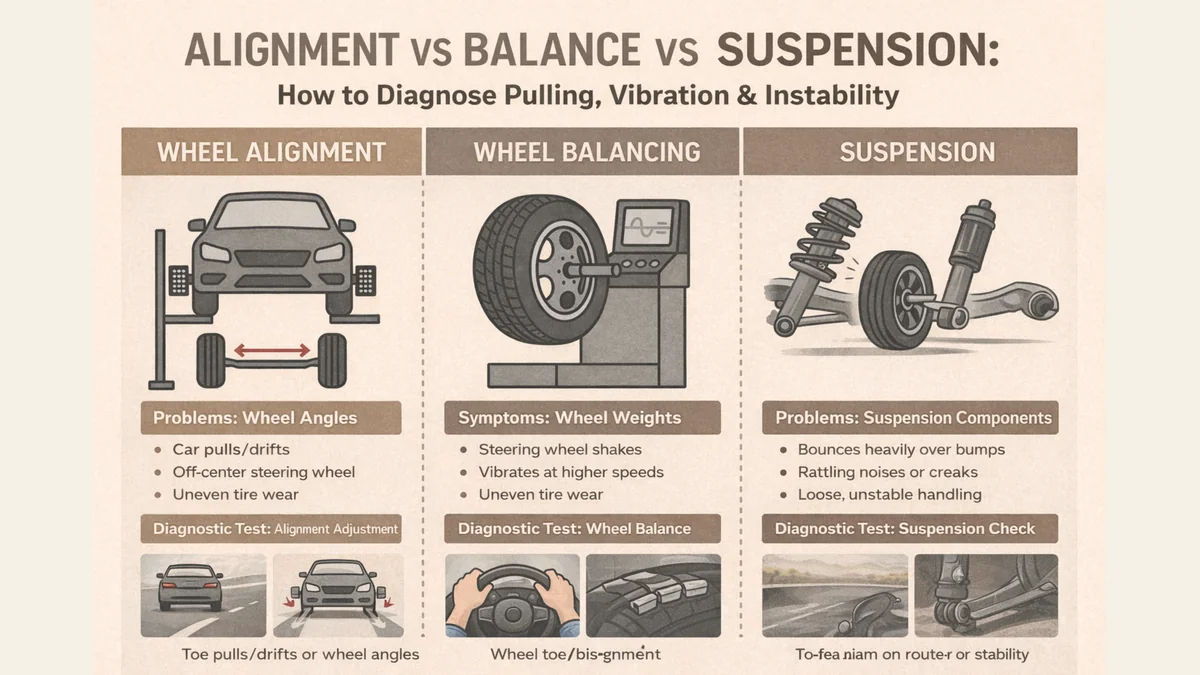
How to Identify the Exact Cause of Pulling, Shaking, or Wandering
Alignment vs balance vs suspension problems are often confused because they create similar driving symptoms. When a car pulls, shakes, or feels unstable, the cause usually comes from one of these three systems rather than the tire itself.
But many handling complaints come from confusion between alignment vs balance vs suspension problems. These three systems affect the vehicle in completely different ways, yet the symptoms often feel similar to the driver.
Understanding which system is responsible helps you repair the correct component the first time instead of replacing parts by
guesswork. In practice, distinguishing alignment vs balance vs suspension faults is the first step before any mechanical repair is attempted.
This guide explains how technicians identify the fault during a road test before lifting the vehicle or removing a wheel.
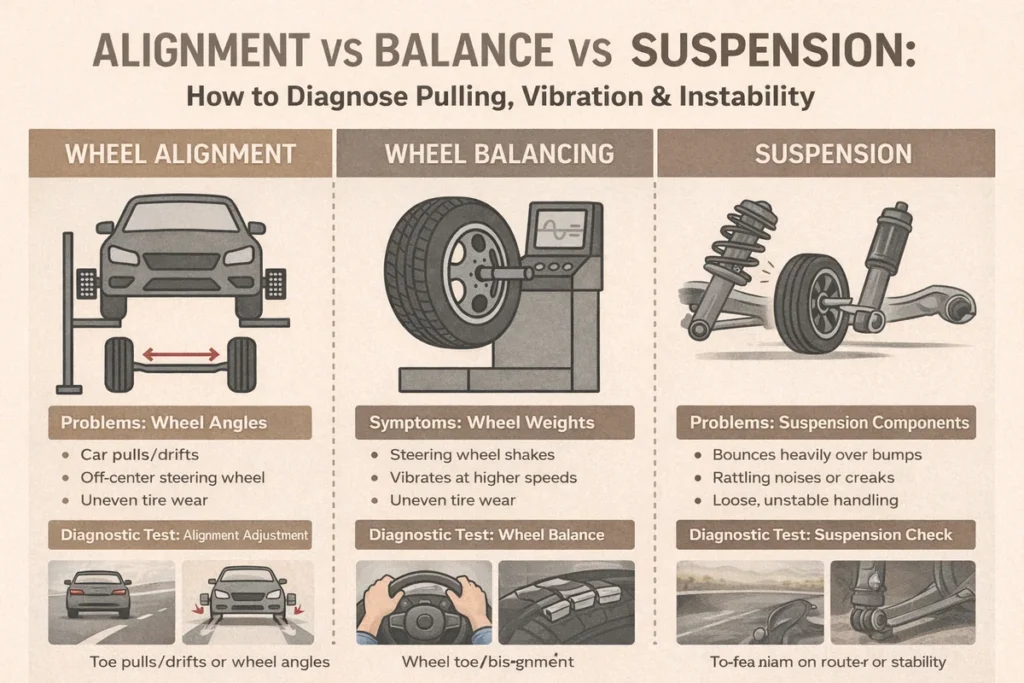
Step 1 — Identify Alignment vs Balance vs Suspension Symptoms
First determine which category best matches your complaint.
| Primary symptom | Most likely system |
|---|---|
| Vehicle changes direction | Alignment |
| Steering wheel shakes | Balance |
| Vehicle feels unstable | Suspension |
| Random movement over bumps | Suspension joints |
| Straight road but wheel tilted | Alignment geometry |
| Smooth road but shaking | Rotational imbalance |
This initial classification is how mechanics separate alignment vs balance vs suspension problems during a road test. If your symptom fits more than one category, continue below to narrow it further.
Alignment Symptoms (Alignment vs Balance vs Suspension Diagnosis)
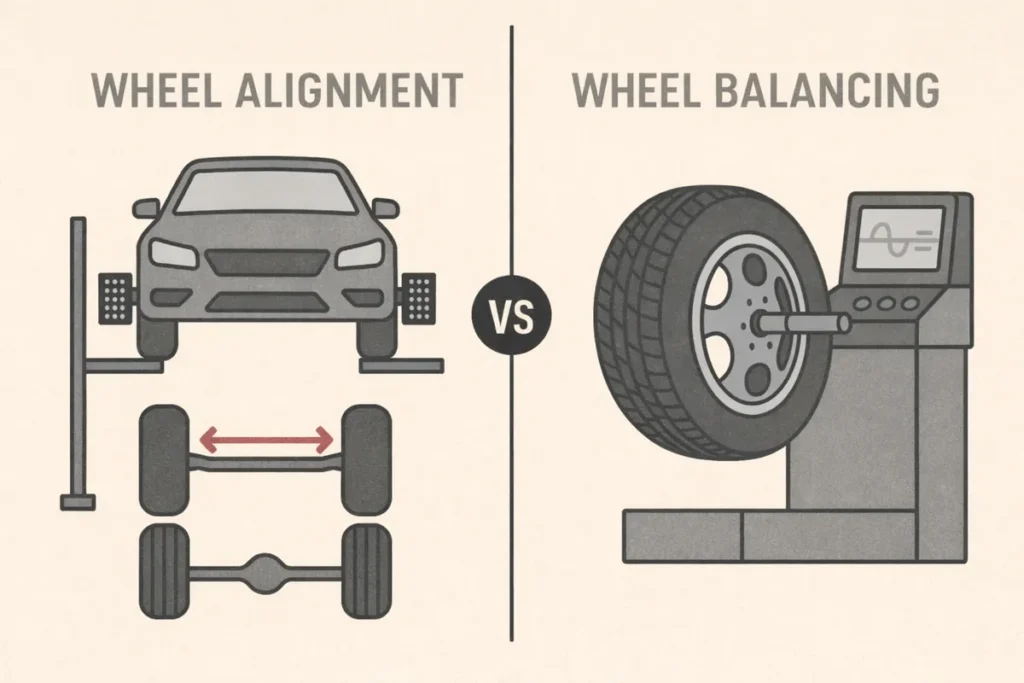
Alignment affects the path the tire naturally wants to follow.
When alignment angles are incorrect, the tire rolls slightly sideways. The driver must constantly correct the steering wheel to keep the vehicle straight.In the alignment vs balance vs suspension comparison, alignment is the only condition that changes vehicle direction rather than smoothness.
Typical Alignment Behaviours
| Driving behaviour | What it indicates |
|---|---|
| Steering wheel not centered | Toe misalignment |
| Car drifts consistently to the same side | Camber or cross-caster |
| Needs constant small corrections | Minor toe error |
| Steering wheel does not return smoothly after a turn | Caster angle issue |
| Vehicle tracks differently between lanes | Alignment sensitivity |
Straight-Road Confirmation Test
Drive at a steady speed on a flat road and gently relax steering effort.
Interpretation
Slow consistent drift → alignment angle issue
Continuous correction needed → toe setting
Pull changes after tire rotation → tire influence, not alignment
Alignment faults create predictable directional bias, not vibration.
Why Alignment Feels Different
Alignment does not depend on speed or engine load.
It affects trajectory instead.
That is why the vehicle:
tracks diagonally
sits off-center in the lane
feels normal on smooth pavement but tiring on long drives
Wheel Balance Symptoms in Alignment vs Balance vs Suspension
Wheel balance determines how evenly weight is distributed while the tire spins.
A wheel rotates hundreds of times per minute. If one section is heavier, the assembly moves up and down once every rotation.Within alignment vs balance vs suspension diagnostics, balance issues are always speed-dependent.
This produces oscillation rather than directional pull.
Typical Balance Behaviours
| Driving behaviour | Interpretation |
|---|---|
| Steering shake within a narrow speed range | Front imbalance |
| Floor or seat vibration | Rear imbalance |
| Smooth below certain speed | Rotation-dependent issue |
| Shake disappears after accelerating past range | Resonance range |
| Appears mainly on smooth roads | Not suspension looseness |
Speed Window Recognition
Each imbalance appears strongest at a specific rotational frequency.
| Speed pattern | Diagnostic meaning |
|---|---|
| Only near highway speed | Dynamic imbalance |
| Gradual increase from low speed | Static imbalance |
| Changes after tire rotation | Wheel position related |
Unlike alignment, balance always follows speed never direction.
Why Balance Does Not Cause Pulling
Imbalance creates vertical oscillation, not sideways movement.
The steering wheel shakes, but the vehicle still travels straight unless another fault exists.
Suspension Symptoms in Alignment vs Balance vs Suspension
Suspension controls how firmly the tire stays planted on the road.
When parts wear, the wheel position changes moment by moment rather than staying fixed.
This produces instability instead of pull or shake.
Typical Suspension Behaviours
| Driving behaviour | Likely component area |
|---|---|
| Vehicle wanders over bumps | Bushings or control arms |
| Feels loose at speed | Shock absorbers |
| Steering correction after bump | Tie rod movement |
| Direction changes with road texture | Compliance wear |
| Requires constant driver attention | Joint free play |
Bump Reaction Test
Drive over a small road imperfection while holding the steering steady.
Observe
Continues straight → normal
Shifts sideways → suspension movement
Steering jerks → linkage play
Alignment produces steady drift.
Suspension wear produces momentary deviation.
Why Suspension Feels Unpredictable
Alignment errors are geometric and repeatable.
Balance errors are rhythmic and speed-related.
Suspension wear is inconsistent because wheel position changes under load.
Drivers typically describe it as:
floating
nervous
unstable
wandering
Steering Feedback Comparison: Alignment vs Balance vs Suspension
Technicians often diagnose using steering feedback alone.
| Steering feedback | Likely system |
|---|---|
| Constant angled steering | Alignment |
| Oscillating steering | Balance |
| Delayed steering response | Suspension |
| Steering reacts after bump | Suspension linkage |
| Steering centered but vibrating | Balance |
| Steering off-center but smooth | Alignment |
Each system affects a different physical axis:
Alignment → direction
Balance → rotation
Suspension → stability
Combined Symptoms What They Usually Mean
Sometimes multiple conditions exist.
| Symptom combination | Typical interpretation |
|---|---|
| Pulling and vibration | Alignment plus imbalance |
| Straight but unstable | Suspension only |
| Shake after pothole | Rim or balance |
| Pull after brake repair | Alignment change |
| New tires but same behaviour | Vehicle system cause |
Technicians isolate the dominant symptom before correcting secondary issues.
Correct Inspection Order Used in Workshops
How Mechanics Diagnose Alignment vs Balance vs Suspension
Check suspension free play
Inspect wheel and rim run-out
Measure alignment angles
Perform wheel balancing
Evaluate tire condition last
Changing this order often leads to repeated repairs because earlier faults affect later measurements.
Why Misdiagnosis Happens
Drivers usually blame whatever was changed most recently:
After tire replacement → blame tires
After alignment → blame alignment
After impact → blame suspension
But the vehicle reacts according to physics, not repair history.
Recognising behaviour patterns prevents unnecessary parts replacement.
The purpose of comparing alignment vs balance vs suspension is to avoid replacing the wrong component.
Alignment vs Balance vs Suspension — Key Differences
| Feature | Alignment | Balance | Suspension |
|---|---|---|---|
| Depends on speed | No | Yes | Sometimes |
| Changes direction | Yes | No | Randomly |
| Steering shake | Rare | Common | Occasional |
| Feels unstable | No | No | Yes |
| Consistent behaviour | Yes | Yes | No |
| Affects trajectory | Yes | No | Indirectly |
Conclusion:
When a vehicle feels wrong, the behaviour itself reveals the source of the problem.
Each system affects the car in a different physical way:
Alignment controls direction — the car travels where the wheels point
Wheel balance controls rotation — the car moves smoothly or shakes
Suspension controls stability — the car feels planted or unstable
Understanding this difference prevents replacing parts blindly.
Alignment vs Balance vs Suspension FAQs
Why is the steering wheel crooked but the car goes straight?
This usually indicates a toe alignment offset. The wheels point correctly relative to each other but not relative to the steering wheel center.
Why does shaking happen only at certain speeds?
Every rotating assembly has a resonance range where imbalance becomes noticeable. Outside that range the oscillation is less perceptible.
Why does the car move sideways after hitting a bump?
The suspension allows momentary wheel angle change due to worn joints or bushings rather than a fixed alignment angle.
Can alignment cause vibration?
Normally no. Alignment changes direction of travel, not rotational smoothness. Vibration typically comes from imbalance or other rotating components.
Why does balancing not fix pulling?
Balancing corrects mass distribution, while pulling is a geometric path issue related to alignment or tire shape.
Why does the car feel unstable even after alignment?
Alignment sets static angles, but worn suspension allows those angles to change dynamically while driving.
Why do mechanics road-test before lifting the car?
Driving behavior reveals which system is involved. Measuring parts first without observing symptoms often leads to incorrect diagnosis.

