

Many drivers know they should check their tire pressure, but far fewer understand what the recommended tire pressure actually means.
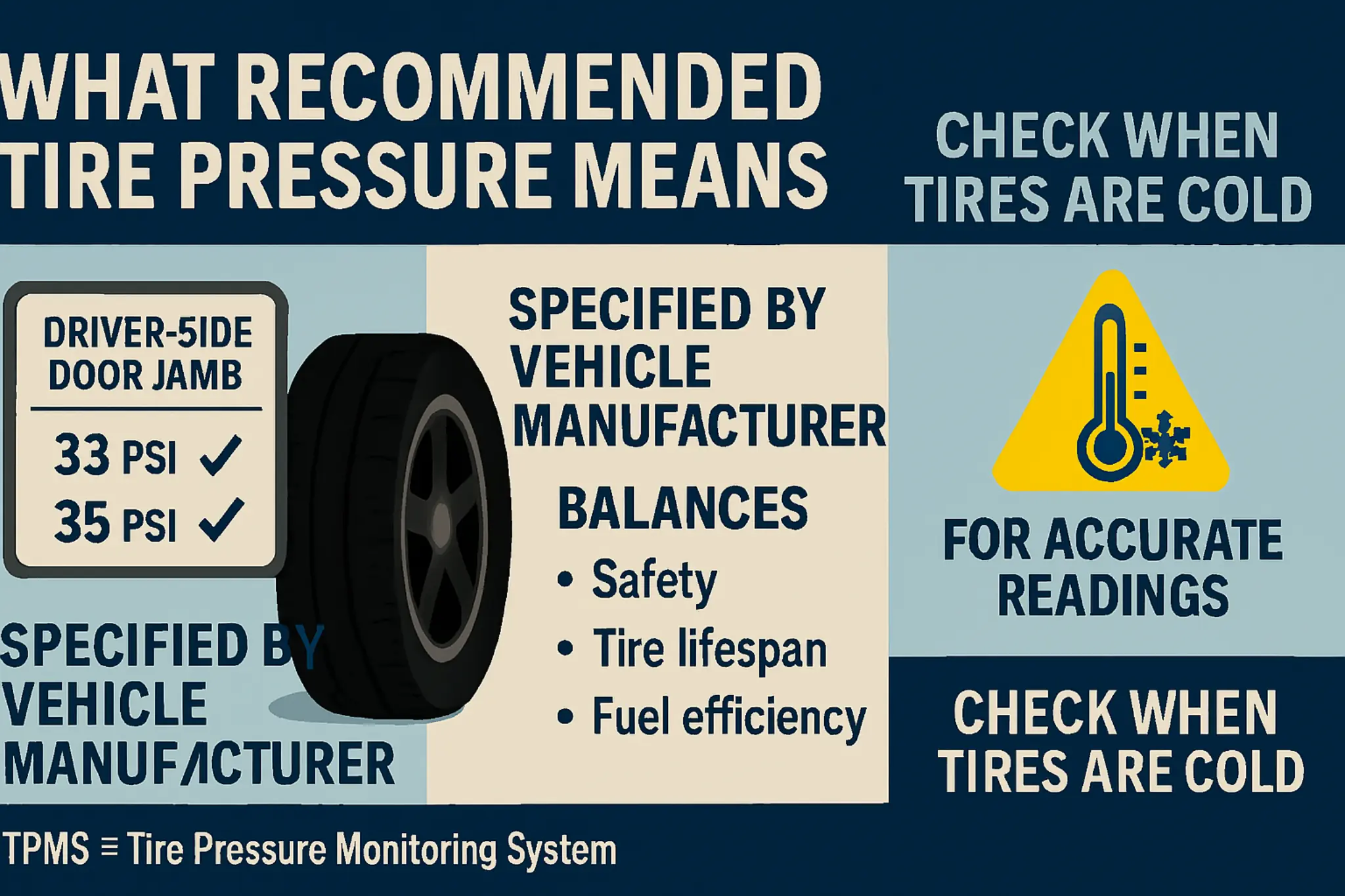
The number listed for your vehicle is not random. Engineers determine the recommended PSI (pounds per square inch) through extensive testing to balance safety, tire lifespan, handling stability, and fuel efficiency.
When tire pressure is correct, the tire maintains its designed shape and contact patch with the road. When pressure is incorrect, traction decreases, wear patterns change, and fuel consumption increases.
Understanding how recommended tire pressure works helps drivers maintain safer vehicles and prevent unnecessary tire damage.
What Recommended Tire Pressure Actually Means
Recommended tire pressure is the inflation level specified by the vehicle manufacturer for normal driving conditions.
This number represents the pressure required to support the vehicle’s weight while maintaining the proper contact area between the tire and the road surface.
Tires are engineered to perform best within a specific pressure range. At this pressure level, the tread distributes the vehicle’s weight evenly, allowing the tire to grip the road effectively during braking, acceleration, and cornering.
If tire pressure drops too low, the sidewalls flex excessively. This increases internal heat and accelerates tire wear.
If pressure is too high, the tire becomes rigid and the center of the tread carries more load than the edges. This reduces traction and causes uneven wear.
The recommended tire pressure is therefore a balance between performance, durability, and safety.
Where to Find Your Vehicle’s Recommended Tire Pressure
Many drivers assume the pressure printed on the tire sidewall is the correct inflation level. This is one of the most common misunderstandings in tire maintenance.
The sidewall number actually represents the maximum pressure the tire can safely hold, not the recommended operating pressure.
Instead, you should look for the recommended tire pressure in these locations:

Driver-side door jamb sticker
Most vehicles display a sticker inside the driver’s door frame. This label lists the correct PSI for both front and rear tires.
Owner’s manual
Vehicle manuals provide recommended pressure values along with additional information about tire maintenance.
Fuel door label
Some vehicles place the recommended pressure information inside the fuel filler door.
Following these manufacturer guidelines ensures the tire performs exactly as intended.
Why Front and Rear Tire Pressure Can Be Different
Many vehicles specify different tire pressures for the front and rear wheels.
This difference exists because vehicles do not distribute weight evenly across all four tires.
In most cars, the engine sits above the front axle, which means the front tires support more weight. As a result, they may require slightly higher pressure.
Rear tire pressure can also differ due to suspension design, passenger seating positions, or cargo loads.
For example, a typical sedan might recommend:
Front tires: 33 PSI
Rear tires: 35 PSI
These variations help maintain balanced handling and braking performance.
Ignoring these differences can affect steering stability and tire wear.
Typical Tire Pressure Ranges for Vehicles
Although every vehicle has a specific recommended pressure, most passenger vehicles fall within similar ranges.
Compact cars and sedans typically operate between 30 and 35 PSI.
SUVs often require slightly higher pressures, usually between 35 and 40 PSI, because they carry more weight.
Pickup trucks and larger vehicles may require even higher pressures, particularly when carrying heavy loads or towing trailers.
These numbers should always be used as general guidance only. The correct tire pressure is always the value listed by the vehicle manufacturer.
Why Tire Pressure Should Always Be Checked Cold
Tire pressure changes naturally with temperature.
When tires heat up during driving, the air inside them expands and increases pressure. This temporary increase can give a false reading if pressure is checked immediately after driving.
For this reason, recommended tire pressure is based on cold tire pressure.
Cold tire pressure means the vehicle has been parked for several hours or driven less than a mile.
Checking pressure while the tires are cold provides the most accurate reading and ensures inflation levels match manufacturer recommendations.
Factors That Can Change Recommended Tire Pressure
Although the manufacturer’s recommended pressure is designed for everyday driving, certain situations may require adjustments.
One example is carrying heavy loads. Additional passengers or cargo increase the weight supported by the tires. Some vehicles provide alternate PSI values for fully loaded conditions.
Towing a trailer can also increase the load on certain tires, especially rear tires.
Temperature changes also affect tire pressure. Air contracts in cold weather and expands in hot conditions.
As a general rule, tire pressure changes about 1 PSI for every 10°F change in temperature.
Seasonal temperature shifts can therefore reduce tire pressure by several PSI during winter months.
Checking pressure regularly helps maintain correct inflation levels throughout the year.
How Incorrect Tire Pressure Feels While Driving
Drivers often notice subtle changes in vehicle behavior when tire pressure is incorrect.

Underinflated tires can make steering feel heavier and less responsive. The vehicle may also feel unstable when cornering or braking.
Because underinflated tires create more rolling resistance, drivers may also notice reduced fuel efficiency.
Overinflated tires produce a different sensation. The ride may feel unusually stiff, and the vehicle may bounce more over bumps.
Because overinflated tires have a smaller contact patch, traction can decrease on wet or slippery roads.
Paying attention to these driving changes can help drivers detect pressure problems before they cause serious damage.
Why Correct Tire Pressure Improves Fuel Efficiency
Tire pressure also plays an important role in fuel consumption.
Underinflated tires create more rolling resistance as they move along the road. This resistance forces the engine to work harder to maintain speed.
Even a small drop in pressure can increase fuel usage over time.
Maintaining recommended tire pressure allows tires to roll efficiently, which reduces energy loss and improves overall fuel economy.
For drivers who travel long distances, this can make a noticeable difference in fuel costs.
Key Takeaway
Recommended tire pressure is carefully calculated by vehicle manufacturers to ensure optimal safety, handling, and tire durability.
Maintaining the correct pressure allows the tire to distribute weight evenly across the tread and maintain proper contact with the road.
Checking tire pressure regularly — especially during seasonal temperature changes — helps prevent uneven tire wear, improves fuel efficiency, and reduces the risk of tire failure.
Although modern vehicles include TPMS systems, manual pressure checks remain an essential part of routine vehicle maintenance.
Recommended Tire Pressure FAQ
What PSI should my tires be?
The correct PSI for your tires is listed on the driver-side door jamb sticker or in the vehicle owner’s manual.
Is 40 PSI too high for tires?
It depends on the vehicle. Some SUVs require pressures close to 40 PSI, but many passenger cars require lower pressures around 30–35 PSI.
Should I inflate tires to the number on the tire sidewall?
No. The number on the tire sidewall indicates the maximum pressure the tire can handle, not the recommended operating pressure.
Why are front and rear tire pressures different?
Vehicles distribute weight unevenly, and different pressures help balance handling and braking performance.
Does cold weather reduce tire pressure?
Yes. Tire pressure typically drops about 1 PSI for every 10°F decrease in temperature.
