



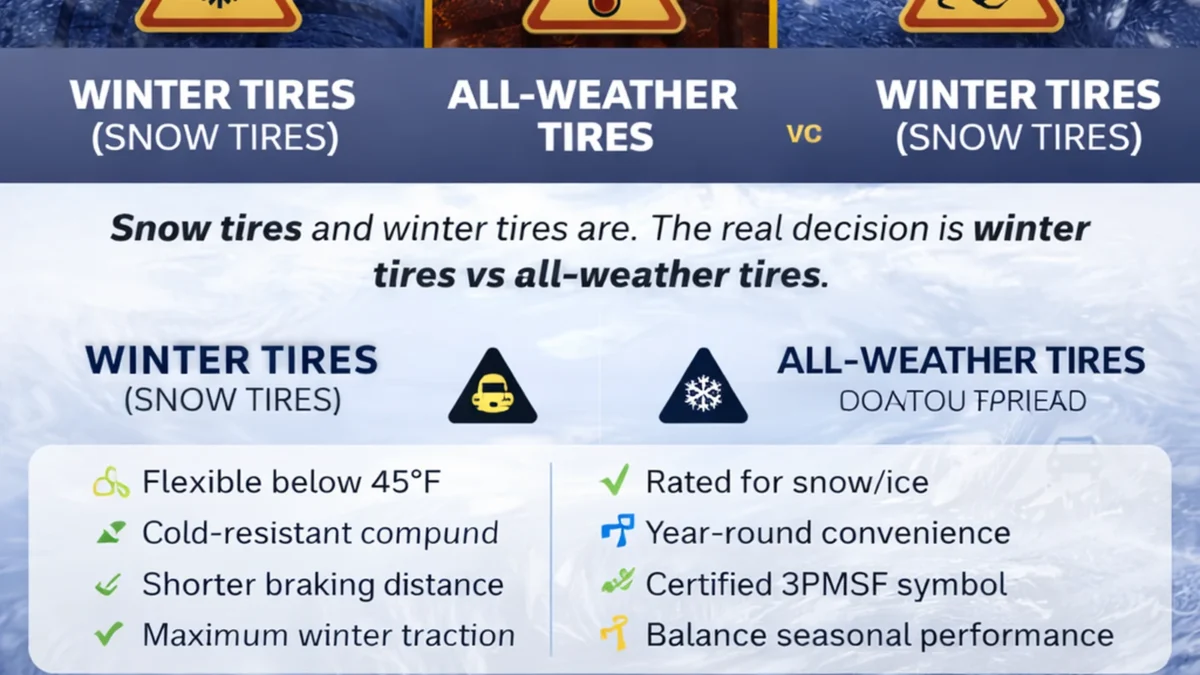
Winter Tires vs Snow Tires vs All-Weather Tires: What’s the Real Difference?
If you’re comparing winter tires vs snow tires vs all-weather tires, the first thing to know is simple: snow tires and winter tires are the same.
However, the real decision today is between winter tires and all-weather tires — and that choice directly affects braking distance, cold-weather traction, and overall safety.
Understanding how these tire types differ requires more than marketing labels. It requires understanding compound chemistry, temperature thresholds, and real-world performance.

Let’s break it down properly.
What Are Winter Tires (Snow Tires)?
Definition: Winter tires are tires specifically designed to remain flexible below 45°F and provide traction on snow and ice.
Winter tires — often called snow tires — are engineered specifically for cold temperatures, ice, snow, and slush.
They are designed to:
Remain flexible below 45°F (7°C)
Provide strong grip on icy surfaces
Improve braking performance in freezing weather
Channel slush and snow efficiently
Unlike all-season tires, winter tires use specialized rubber compounds that do not stiffen in cold conditions. This flexibility increases traction even on dry but cold pavement.
The key advantage of winter tires is not just tread pattern — it is compound elasticity at low temperatures.
Are Snow Tires Different from Winter Tires?
No.
“Snow tire” is simply an older term. Modern winter tires are designed for much more than snow. They perform better in cold dry conditions, icy intersections, freezing rain, and packed snow.
Today, the correct technical term is winter tire.
If you see “snow tire” in marketing, it refers to the same category.
What Are All-Weather Tires?
All-weather tires are designed to be used year-round while still offering certified winter traction.
Unlike all-season tires, all-weather tires carry the Three-Peak Mountain Snowflake (3PMSF) symbol. This means they have passed standardized winter traction testing.
However, all-weather tires are built with a compound that operates across a wider temperature range. They remain flexible in cold conditions but are also stable in warmer months.
In short:
Winter tires = maximum winter performance
All-weather tires = balanced year-round performance
The Science Behind the Difference: Compound Chemistry

The biggest difference in the winter tires vs snow tires vs all-weather tires comparison is compound behavior.
Rubber is temperature sensitive.
Below approximately 45°F (7°C), many all-season tires begin to harden. As rubber stiffens, it loses its ability to conform to microscopic road textures. This reduces friction and increases stopping distance.
Winter tires use:
Higher silica content
Cold-resistant polymers
Flexible tread blocks
These compounds stay pliable in freezing temperatures.
All-weather tires also include winter-capable compounds but are slightly firmer than dedicated winter tires. That firmness improves summer durability but reduces peak winter traction compared to full winter tires.
This is not branding. It is chemistry.
Winter Tires vs All-Weather Tires: Performance Comparison
Cold Dry Pavement (Below 45°F)
Winter tires maintain maximum flexibility and shorter braking distances.
All-weather tires perform well but slightly less effectively in extreme cold.
Advantage: Winter tires.
Deep Snow
Winter tires use aggressive tread patterns and dense siping to bite into snow.
All-weather tires provide solid traction but lack the same depth and edge density.
Advantage: Winter tires.
Ice
Ice requires compound softness more than tread depth. Winter tires remain softer and generate better micro-friction.
Advantage: Winter tires.
Slush and Wet Snow
Both tire types perform well if tread depth is sufficient.
Advantage: Comparable, slight edge to winter tires in heavy slush.
Warm Spring Conditions
Winter tires wear faster in temperatures above 50°F.
All-weather tires are more stable and durable in fluctuating climates.
Advantage: All-weather tires.
Understanding Tire Symbols: 3PMSF vs M+S
A major source of confusion in the winter tires vs snow tires vs all-weather tires discussion is certification marking.
M+S (Mud + Snow)
This marking only indicates tread design characteristics. It does not require performance testing.
Many all-season tires carry this marking, yet they are not winter certified.
Three-Peak Mountain Snowflake (3PMSF)
This symbol indicates that the tire has passed a standardized snow traction test.
Both winter tires and all-weather tires carry this certification.
However, winter tires are optimized exclusively for cold weather, while all-weather tires balance winter certification with summer usability.
Certification alone does not mean identical performance.
The 45°F Rule: When Should You Install Winter Tires?
Temperature — not snowfall — determines when winter tires become necessary.
When daily average temperatures consistently drop below 45°F (7°C), winter tires begin to outperform all-season alternatives.
Cold pavement alone reduces traction.
If freezing temperatures persist for months, winter tires provide measurable braking advantages.
If your winter climate is moderate and inconsistent, all-weather tires may provide adequate performance without seasonal changes.
Real-World Braking Differences
While exact braking distances vary by vehicle and surface, independent testing consistently shows:
Shorter stopping distances with winter tires on ice and snow
Improved cold-weather braking even on dry pavement
Reduced traction for all-season tires below freezing
All-weather tires narrow the performance gap compared to all-season tires, but they do not fully match dedicated winter compounds in extreme cold.
This difference can matter during emergency braking situations.
Convenience vs Maximum Safety Margin
The choice between winter tires and all-weather tires often comes down to lifestyle.
Winter tires require seasonal installation and storage. That means additional planning and cost.
All-weather tires eliminate seasonal changes. They simplify ownership.
However, convenience comes with a slight trade-off in peak winter performance.
In harsh climates with extended freezing periods, winter tires provide the highest safety margin.
In moderate climates with occasional snow, all-weather tires may provide sufficient balance.
Cost Considerations
At first glance, winter tires seem more expensive because they require a second set.
However, alternating between two sets often extends overall tire lifespan. Each set is used only part of the year.
All-weather tires reduce upfront complexity but may wear faster if exposed to extreme seasonal shifts.
Long-term cost depends on climate severity and annual mileage.
Climate-Based Recommendation Guide
Choose winter tires if:
Temperatures stay below 45°F for months
Ice and packed snow are common
You drive on untreated or rural roads
You prioritize maximum cold-weather traction
Choose all-weather tires if:
Winters are mild to moderate
Snowfall is occasional
You want year-round convenience
You primarily drive in urban areas
The right choice depends on climate, not advertising.
According to tire engineering studies, rubber compound flexibility below freezing temperatures is one of the primary factors affecting braking distance on cold pavement.
Final Verdict
In the winter tires vs snow tires vs all-weather tires comparison, snow tires and winter tires are the same.
The real decision is between dedicated winter tires and all-weather tires.
Winter tires provide maximum traction in freezing temperatures, snow, and ice.
All-weather tires offer certified winter performance with year-round convenience.
The difference lies in compound flexibility, temperature range, and braking performance.
Your climate determines the right choice.
Because tires do not respond to marketing terms.They respond to temperature.
Frequently Asked Questions
Are winter tires and snow tires the same?
Yes. Snow tires is an older term for winter tires. They refer to the same category.
Are all-weather tires better than winter tires?
Not in severe winter conditions. Winter tires provide stronger traction in extreme cold, ice, and deep snow. All-weather tires offer balanced year-round usability.
Can I use winter tires year-round?
You can, but they wear faster in warm weather and may reduce handling precision in summer conditions.
What does the 3PMSF symbol mean?
It indicates that a tire has passed standardized winter traction testing and is certified for severe snow performance.
Do I need winter tires if I have AWD?
Yes. All-wheel drive improves acceleration traction but does not improve braking grip. Tire compound determines stopping performance.
When should I switch to winter tires?
When average daily temperatures consistently remain below 45°F (7°C).
