

What Is Tire Maintenance & Safety?
Tire maintenance & safety means regularly checking, adjusting, and inspecting tires so they perform exactly as engineers designed them to.
You don’t “maintain tires” to keep them looking nice.
You maintain them to keep rubber, air pressure, and traction working together — because that’s what actually keeps a car on the road.
A properly maintained tire must:
Hold correct air pressure
Maintain safe tread depth
Wear evenly
Stay free from structural damage
Grip road surfaces in dry and wet conditions
Modern tires operate like engineered safety devices. Manufacturers like Michelin and Bridgestone design tread patterns to channel water, stabilize braking, and prevent hydroplaning. When maintenance stops, those engineered features stop working too.
So tire care isn’t cosmetic maintenance.
It’s active safety management.
Why Tire Maintenance Matters
Your car touches the road through four palm-sized patches of rubber.

Everything — braking, turning, accelerating — depends on those contact patches.
1. Stopping Distance Changes Dramatically
Consumer Reports testing shows worn tires can increase wet braking distance by over 25–30 feet at highway speed compared to new tires.

That’s not a statistic — that’s the difference between:
stopping safely
or hitting the car ahead
2. Fuel Economy Depends on Tire Pressure
The U.S. Department of Energy states under-inflated tires can reduce fuel economy by up to 3%.

Low pressure increases rolling resistance.
The engine works harder.
You pay more.
3. Blowout Risk Increases With Neglect
Heat is the enemy of tires.

Low pressure → more flexing → more heat → structural failure
Most highway blowouts come from slow pressure loss that drivers ignored.
4. Handling Stability Changes
Uneven wear causes:
steering vibration
pulling to one side
longer braking time
loss of wet traction
You don’t “get used to it.”
You slowly adapt to unsafe driving.
5. Legal and Insurance Implications
Driving on bald tires can violate safety regulations in many countries. After an accident, investigators often check tread depth and pressure condition.
Maintenance protects both safety and liability.
Step-by-Step Guide (Basic Tire Maintenance Checklist)
You don’t need a garage schedule. You need a simple routine.
Follow this monthly process.
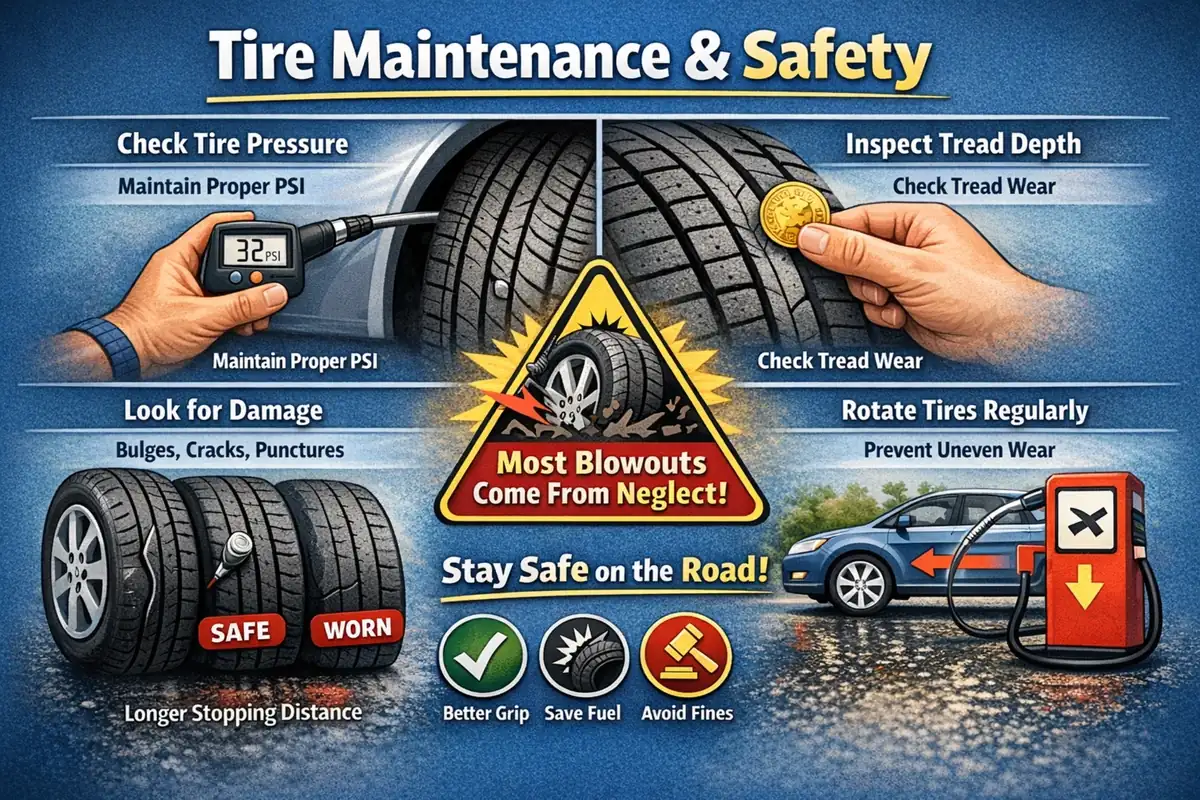
Step 1 — Check Tire Pressure (Monthly)

Use a digital gauge when tires are cold.
Find the recommended PSI on the driver-side door sticker, not on the tire sidewall.
Why?
The tire shows maximum pressure.
The car manufacturer sets the correct operating pressure.
Also understand TPMS basics:
Your Tire Pressure Monitoring System warns only when pressure drops dangerously low — not when it becomes inefficient. A steady light means low pressure. A flashing tire pressure light usually indicates sensor malfunction (covered in our TPMS guide).
Step 2 — Inspect Tread Depth

Use the coin test (or tread gauge):
If tread depth drops below 1.6 mm (2/32 inch), the tire becomes legally and functionally unsafe in wet conditions.
Tip: check both edges — uneven wear reveals alignment issues.
Step 3 — Look for Visible Damage
Walk around your car and check:
cracks (dry rot)
bulges
embedded nails
sidewall cuts
Dry rot often appears before tire age limit — especially in hot climates.
Step 4 — Rotate Tires Every 8,000–10,000 km
Rotation prevents uneven wear between front and rear tires.

Front tires usually wear faster because they steer and brake.
Step 5 — Listen While Driving
Your car talks.
You just have to stop ignoring it.
New humming?
Rhythmic thumping?
High-pitch whine?
Those are classic tire noise symptoms indicating cupping, imbalance, or belt separation.
Step 6 — Check Age (Not Just Wear)
Most manufacturers recommend replacing tires after 6–10 years, regardless of tread.
Rubber hardens over time. Grip disappears long before tread looks worn.
Find the DOT date code on the sidewall (4 digits = week + year).

Step 7 — Maintain Proper Inflation During Temperature Changes
Pressure drops roughly 1 PSI for every 5–6°C temperature decrease.

Winter mornings often trigger TPMS lights — not because the tire failed, but because physics worked.
Common Mistakes That Cost Drivers Money
Drivers don’t ignore tires intentionally.
They misunderstand them.
Here are the most expensive habits.
1. Using the Sidewall PSI
This over inflates tires.
Result:
harsh ride
uneven center wear
reduced wet grip
2. Ignoring Small Pressure Loss
A tire rarely goes flat overnight.
It slowly loses air over weeks.
That’s why monthly checks matter.
3. Skipping Rotation
You don’t “save money” by avoiding rotation.
You actually cut tire lifespan by up to 30–40% (tire manufacturer service data).
4. Waiting Until Tires Look Bald
Wet traction disappears long before tires appear smooth.
Hydroplaning risk rises dramatically at 3–4/32 inch.
5. Mixing Different Tire Types
Different tread patterns and grip levels can destabilize braking and emergency handling.
6. Driving on Warning Signs
Never ignore:
vibration in steering wheel
repeated air loss
visible cords
bulging sidewall
flashing tire pressure light
Each indicates structural risk.

Tools & Resources
Good news — tire maintenance costs less than a coffee per month.
Basic Home Tools
Keep these in your car:
Digital tire pressure gauge
Portable air compressor
Tread depth gauge
Flashlight
They pay for themselves in fuel savings alone.
Trusted Safety Resources
For reliable guidance, consult:
NHTSA tire safety guidelines
Tire manufacturer manuals (Michelin, Bridgestone, Continental)
Vehicle owner’s manual
Avoid social media “hacks.”
Tires obey physics, not viral videos.
Professional Services Worth Paying For
Some tasks require experts:
wheel alignment
balancing
puncture repair
TPMS sensor replacement
Skipping them causes faster wear — and higher replacement cost.
Environmental & Financial Costs of Ignoring Tire Maintenance
Neglected tires don’t just hurt your wallet.
They increase:
fuel consumption
emissions
premature tire disposal
According to the U.S. Department of Energy, proper inflation alone improves efficiency and reduces carbon output.
Better maintenance = fewer tires in landfills.
FAQs
How often should I check tire pressure?
Once per month and before long trips. Always when tires are cold.
Can I drive on bald tires temporarily?
No. Wet braking performance collapses dramatically below legal tread depth.
Why does my tire pressure light come on in winter mornings?
Cold air contracts, reducing pressure. Add air to the recommended PSI — don’t ignore it.
Do new tires need maintenance?
Yes — especially rotation and pressure checks. Neglect shortens their lifespan fastest during the first year.
When do tires become unsafe to drive?
Unsafe conditions include:
tread below legal limit
visible cords
bulges
sidewall cracking
repeated pressure loss
Is tire noise normal?
Some road noise is normal. Rhythmic humming or vibration isn’t — it indicates wear pattern issues.
Conclusion
Tire maintenance isn’t complicated.
It’s a habit.
Spend 5 minutes per month and you gain:
safer braking
predictable handling
longer tire life
lower fuel cost
fewer emergencies
Ignore it, and tires silently degrade until the day they fail — usually at the worst possible time.
This guide introduced the core of tire maintenance & safety.
Next, we’ll dive deeper into individual topics like bald tires, tire dry rot, tire noise diagnosis, TPMS lights, and rotation patterns — so you can handle every tire situation confidently.
